

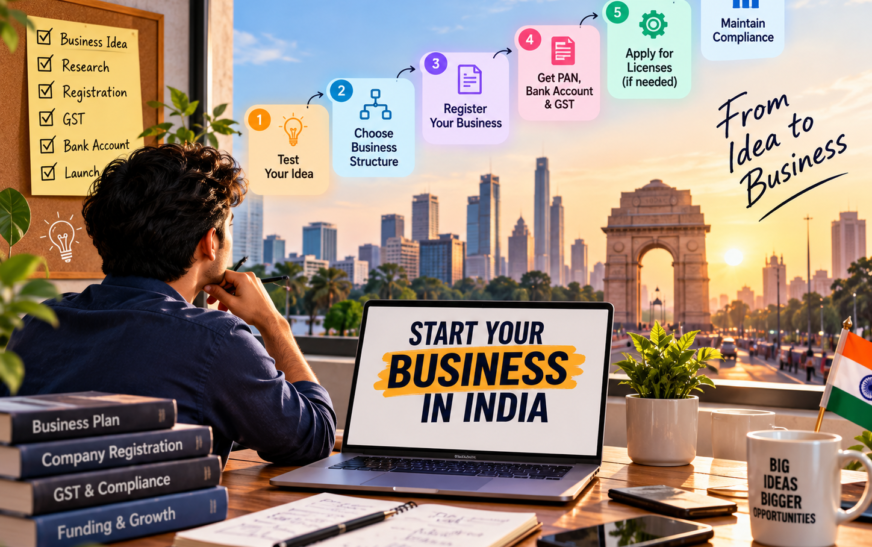
Every Indian family has that relative who boasts about “Beta, naukri kar lo, business mein bahut risk hai,” and now India has one of the most vibrant startup ecosystems in the world and better unit economics than your local chai wala. So, you want in. This is a guide to how to start a business in India from day zero to the first GST return, without making you cry into the Ganga. We’ve included costs as of October, 2026, and highlighted points that are particularly prone to change, as Indian rules are not set in stone. Especially on Fridays.
Grab your chai; let’s go.
The TLDR
If you’re skim reading, here’s a quick summary of how to start a business in India:
1. Run a test on your idea before you waste your life on it.
2. Decide on the business structure you want to adopt.
3. Register your business as per your chosen business structure.
4. Get your PAN, bank account, and (if applicable) GST done
5. Register on the Udyam portal to get MSME benefits.
6. Apply for relevant licenses and other optional clearances such as DPIIT (Startup India) recognition.
7. Maintain compliance to avoid surprise phone calls from authorities.
And here’s the long version, with the good stuff.
How to Start a Business in India: Step-by-Step Guide
1. Test your idea before you invest sweat equity.
Before the exciting part of applying for company registration, ask yourself one question: Will a stranger pay for this?
Not your mother. Not your college friend. An actual stranger.
If you can manage to sell even one product or service to ten different people, you’re good to go. If not, save yourself the heartache and five lakhs in GST registration. How? Run a small test. Create a WhatsApp catalog, an Instagram page, a sample product, or a Google form with a UPI ID, or set up a small stall this weekend and see how many people would buy from you. If you can get at least one sale from ten different people, congrats! You have an idea worth pursuing. If not, move on.
Also, write down this magic page. If you can’t fill this page, no amount of company registration will help your business.
2. Decide on a structure to start a business in India.
This is the part where most people get confused and wind up in tax hell later. This is your cheat sheet on business structures in India:
- Sole Proprietorship: You are your business. Easy and cheap to set up since you don’t have to register it with the Ministry of Corporate Affairs, but you bear all risk and responsibility. Suitable for small-scale operations and testing an idea.
- One Person Company: Similar to a sole proprietorship, but you’re liable for only your share in the company, and you don’t need a co-owner.
- Limited Liability Partnership: An LLP has two or more partners, who bear limited liability. It is a popular choice among professionals and consultants since it offers the flexibility of a partnership and limited liability. Filed as a FiLLiP form on the MCA website.
- Private Limited Company: The default structure for most serious startups. Set up as a separate legal entity, Pvt Ltd allows for raising capital and issuing employee stock options and is preferred by venture capitalists. However, you have to file additional forms and pay extra taxes as a Pvt Ltd company.
A general rule of thumb is to start a sole proprietorship if you want to test an idea, or if you don’t want to bear additional tax liability. Go for a Pvt Ltd if you want to raise capital or hire people. An LLP is a good choice if you want to start a professional services firm with a few friends and no intention of raising capital.
3. Register your business in India.
Let’s assume you want to start a Pvt Ltd company, since that seems to be the default structure for most people these days. The good news is that most of the process has been digitized, and most of the forms you need to fill are in one place: the SPICe+ form on the MCA website. This one form covers name approval, incorporation, DIN (Director Identification Number), PAN, and TAN.
Things you’ll need to get before applying:
- 2 directors and 2 shareholders (could be the same people)
- At least 1 director who is a resident of India (has stayed in India for 182 days or more in the previous financial year)
- Registered office address in India (along with proof of address)
- Identity and address proof for each director
- Digital signature of each director
Note: There is no minimum paid-up capital anymore. Many people are surprised to know that you can start a company with zero capital, since the “one lakh authorization” myth has been dispelled.
How it works:
- Part A of the SPICe+ form is for name approval. You can apply for up to two names, and the name should end with the words “Private Limited.” Make sure to do a trademark search and availability check before applying, or you’ll just waste your time.
- The next part, Part B, asks for details of your directors, share capital, and office address. You can also apply for EPFO, ESIC, and bank account opening alongside your application in Part C.
- After you’ve applied, you will receive your certificate of incorporation along with your company PAN and TAN.
The whole process usually takes between 5 to 15 working days if everything is in order.
How much does it cost to start a Pvt Ltd company in India?
As of 2026, the MCA filing fees are practically zero for companies with an authorised capital of up to Fifteen Lakhs. You’ll have to pay additional fees for stamp duty (varies from state to state – expect to pay more in Maharashtra or Karnataka), digital signature, and professional fees. The entire cost usually falls between Rs. 7,000 to Rs. 25,000 for Pvt Ltd registration, depending on your location and professional fees. An LLP or OPC (One Person Company) is cheaper to register.
Note: Stamp duty and other fees vary depending on the state you’re registering in. Always check the most recent notifications on the MCA website.
4. Open a current account and get tax-related documents.
Once you’ve received your certificate of incorporation, open a current account in the company’s name. The bank will ask for your certificate of incorporation, company PAN, your Memorandum of Association and Articles of Association, and a board resolution. Maintain separate personal and business accounts at all times, or your accountant will have an aneurysm by the end of the year.
If you’re a sole proprietor, you don’t need a separate PAN. You can use your existing PAN to open a current account, along with a proof of proprietorship. This could be your Udyam certificate (explained below) or GST certificate, if you have one.
5. Know about GST registration for new businesses
No one likes GST, but it is a necessary evil. Here’s what you need to know:
When to register for GST?
Your business will be mandated to register for GST if your turnover (total sales) exceeds:
State of Goods/Services Turnover
Normal Category States Goods 40 Lakhs Services 20 Lakhs Goods + Services 20 Lakhs (Goods) and 10 Lakhs (Services) Special Category States
Even if your turnover is lower than the numbers stated above, you might need to register for GST if:
- You are a seller on e-commerce platforms
- You deal in interstate supply of goods
- You are a non-resident Indian supplying services online
Can I register voluntarily?
Many small businesses choose to register voluntarily, since many big businesses only deal with registered suppliers, and GST registration makes it easier to claim input tax credit.
What is the GST rate?
After the GST council meeting in September 2025, most goods and services fall under the 5% and 18% tax slab, with a 40% tax slab for luxury and sin items. Always check the GST website for your goods/service, since there are specific exemptions for certain products.
How to register for GST?
Register on the GST portal with your PAN, Aadhaar, bank details, and address proof. It’s completely free if you register yourself, and it usually takes a few working days to clear.
Pro tip: Set reminders on your phone for GST return due dates, since the penalty for late filing is steep, both for the company and its directors.
6. Register on the Udyam portal for MSME benefits
This is one step many forget to take, because no one remembers it. But trust me, it is worth your five minutes.
MSME stands for Micro, Small and Medium Enterprises, and businesses that register on the Udyam portal (the official website for MSME registration) are eligible for benefits such as collateral-free loans, priority sector lending, subsidies on certifications, and protection against delayed payments from bigger companies. The process is completely online and free of cost, and you just need your Aadhaar card to register.
How to determine if your business qualifies?
The MSME classification has changed as of 1st April, 2025, and now takes into account both investment in machinery and equipment, and the turnover.
Investment Turnover
Micro 250Crore 100Crore
Small 25Crore 10Crore
Medium 125Crore 500Crore
Investment in machinery and equipment refers to the amount spent on purchasing machinery, equipment, and furniture for the business. Turnover refers to the total sales made by the business, excluding turnover from exports. Since the Udyam portal is connected to the Income Tax Department and GSTN, it automatically pulls in your turnover and investment details – so don’t lie about it.
Note: Several articles online still mention the previous MSME limits. Ignore them. The new rules have been in place since April 1st, 2025.
Microenterprises registered on the Udyam portal are eligible for credit cards with a credit limit of Rs. 5 Lakhs, as announced in the Budget 2025. However, the details are subject to change, and the availability depends on the bank, so ask your preferred bank about it.
Does it cost anything to register on the Udyam portal?
It is completely free of cost on the official website. If any website asks you to pay a fee for Udyam registration, it is a scam – run away!
7. Apply for DPIIT recognition (Startup India)
This is optional, and pertains only to innovative or scalable businesses. A small-time restaurant owner doesn’t need this, while a tech startup or a manufacturer might benefit from this.
Benefits of DPIIT (Startup India) recognition:
Tax exemption under Section 80-IAC for three consecutive years, up to a profit of Rs. 50 Lakhs. Note that this benefit is not automatic, and you’ll have to apply separately to the Inter-Ministerial Board for approval. Also, your turnover for the year of claiming the exemption should not exceed Rs. 100 Crore. Self-certification for certain labor and environment-related laws. Norms for government tenders eased.
As of 2026, the turnover limits for DPIIT recognition have been changed to Rs. 200 Crore for general categories and Rs. 300 Crore for deep-tech startups, while the turnover limit for claiming tax exemption under 80-IAC remains at Rs. 100 Crore. Rules are subject to change, so always check the Startup India website before applying.
8. Get the relevant licenses for your business
Your company registration makes you legal, but you still need licenses to operate in your chosen field. Some of the most common licenses are:
- Shop and Establishment License from your state or local authority if you have a physical retail outlet
- FSSAI license if you are in the food business, including cloud kitchens and manufacturing
- Trade license from your local authority, depending on your business
- IEC (Import Export Code) if you are involved in import or export of goods
- Trademark registration for your business name and logo, to prevent copying
- Other professional tax and license registrations if you employ people
The best way to know what licenses you need is to search “[your business type] trade license [your state]” on Google and check which documents you need to apply for. You can also consult a local lawyer or the relevant authority’s website.
9. Maintain compliance to avoid issues down the line
No one likes to do compliance, but it is necessary for a smooth functioning of your business, and to avoid late fees or legal issues. Some common compliance requirements are:
- GST returns on due dates (monthly or quarterly, depending on your turnover)
- Income Tax returns every year, and advance tax if applicable
- TDS (tax deducted at source) if you’re paying salary, rent, or other expenses above a certain threshold limit
- Filing of company tax returns with the Registrar of Companies, and an audit for Pvt Ltd companies regardless of income
- Books of accounts, updated on a regular basis and not left till the end of the financial year
Hiring a good Chartered Accountant or using accounting software will save you a ton of headaches. The Rs. 2,000 you pay every month to your CA is much better than the Rs. 50,000 fine you’ll have to pay if you don’t file income tax returns on time.
Top 5 mistakes first-time entrepreneurs make
- Register a Pvt Ltd company before they have their first customer. Sometimes, it’s best to test the waters with a sole proprietorship first.
- Skipping Udyam registration to get MSME benefits. It is absolutely free, so there’s no reason not to do it.
- Mixing personal and business expenses. Your CA will definitely not appreciate it.
- Going for an agent who promises to do everything for Rs. 499, but then asking for additional payment for various reasons. They are scams.
- Not knowing which rules apply to you, based on your state. Many states have different requirements.
An approximate cost to start a business in India
Because everyone asks, here’s a rough picture for a small service business, not a promise:
- Company registration (Pvt Ltd): Rs. 7,000 – Rs. 25,000
- GST registration: Free
- Udyam registration: Free
- Trademark registration: Varies
- Website development, including domain name: A few thousand to a few lakhs, depending on your design and requirements
- Cost for CA/bookkeeping: A few thousand rupees, if you go for a small business package
Product-based businesses will additionally require inventory and equipment, which could cost anywhere from a few thousand to several crores, depending on your product and target audience. Make sure to create your own cost sheet, and add a healthy buffer to it, since costs are almost never as mentioned on paper.
FAQs
- How do I start a business in India with no money?
Start as a sole proprietor with a service. Sell skills such as writing, designing, or tutoring. Use Udyam registration (free) and GST registration (also free if you reach the turnover threshold) and move to a Pvt Ltd structure only when you have a consistent stream of paying customers.
- What is the first step to start a business in India?
Validate your idea with real customers, and decide on a business structure suited to your needs. Only then should you get your company registration done.
- Which business structure is best for starting a business in India?
It depends on your needs. A sole proprietorship is the easiest to register, while a Pvt Ltd is preferred for raising capital. An LLP is a good option for professionals such as lawyers and consultants.
- How much does it cost to register a company in India?
It depends on the structure you choose, but as a rough estimate, you can expect to pay between Rs. 7,000 to Rs. 25,000 to register a Pvt Ltd company in India in 2026. Always confirm the most recent figures on the MCA website, since the filing fees are subject to change every financial year.
- How long does business registration take in India?
It usually takes 5-15 working days to register a Pvt Ltd company in India if your documents are in order. GST registration can be done online in a few days, and Udyam (MSME) registration can be completed in a matter of hours.
- Is GST registration mandatory for a small business?
Yes, if your turnover (total sales) crosses Rs. 40 Lakhs (goods), Rs. 20 Lakhs (services), or Rs. 20 Lakhs (goods) and Rs. 10 Lakhs (services) if you’re in a special category state. You can also choose to register voluntarily for GST if you want to quote a GSTIN to your customers.
- What is MSME registration and is it worth it?
MSME stands for Micro, Small and Medium Enterprises Development Corporation, and it’s a government-run body that gives benefits to small businesses. The Udyam portal is the official website for MSME registration, and it is completely free of cost. It is worth your time since it makes you eligible for benefits such as collateral-free loans, and protection against delayed payments from big companies. Most small businesses should go ahead and register.
- What are the current MSME limits?
As of April 1st, 2025, a micro enterprise has an investment of up to Rs. 2.5 Crore and a turnover of up to Rs. 10 Crore. A small enterprise has an investment of up to Rs. 25 Crore and a turnover of up to Rs. 100 Crore. A medium enterprise has an investment of up to Rs. 125 Crore and a turnover of up to Rs. 500 Crore.
- Can I run a business in India while working a full-time job?
It depends on your employer. Many people start a business on the side, and some companies are okay with it as long as it doesn’t interfere with your primary job.
- Can a foreigner or NRI start a business in India?
Yes, NRIs and foreigners can start a business in India, subject to certain conditions. A Pvt Ltd company must have at least one director who is a resident of India.
- Do I need a CA to start a business in India?
Not mandatory, but a good CA goes a long way in helping you choose the right business structure, and ensures that your filings are done on time. It is advisable to hire one for a Pvt Ltd, or if you have employees and GST registration.
Final thoughts
Here’s the reality check: most of the paperwork for how to start a business in India is simple and straightforward. The hard part is finding customers and convincing them to part with their hard-earned money. Focus on getting your company registered, GST and Udyam done, and then spend your time and effort on generating sales, and not on paperwork. That’s how you build a sustainable business.
If you have any other questions about how to start a business in India, feel free to ask in the comments below, or contact The Biz Stage directly, and we’ll help you find the right answer.
Disclaimer: The information provided in this blog is for general informational purposes only and should not be considered as legal, tax, or financial advice. Thresholds, fees, and rules are subject to change, so always check the most recent information on the applicable government websites (such as MCA, GST, Udyam, Startup India) or consult with a qualified professional before taking any action.