
Every big business was small once. Somebody had an idea, probably got told it wouldn’t work, and built it anyway. That’s true for most founders, but it carries a bit more weight when you look at the women who’ve done it in industries that weren’t exactly rolling out the welcome mat for them.
This isn’t a list of overnight success stories, because honestly, those barely exist. What you’ll find here are seven women entrepreneurs who took real risks, made real mistakes, and built businesses that are still standing today. If you’re building something yourself, or just need a reminder that it’s possible, these stories are worth fifteen minutes of your time.
Why Stories of Women Entrepreneurs Matter Right Now
There’s a reason women-led startups and women-owned businesses keep coming up in business conversations these days. It’s not just a trend. Women founders are building companies across sectors that used to be almost entirely male dominated, finance, beauty tech, consumer products, even industrial manufacturing. And they’re not just building, they’re scaling into some of the most valuable companies in their industries.
Reading about successful women entrepreneurs does more than inspire. It gives you an actual playbook, the decisions that worked, the ones that didn’t, and the mindset that kept them going when things got hard. That’s the kind of entrepreneurship for women that’s actually useful, not just motivational.
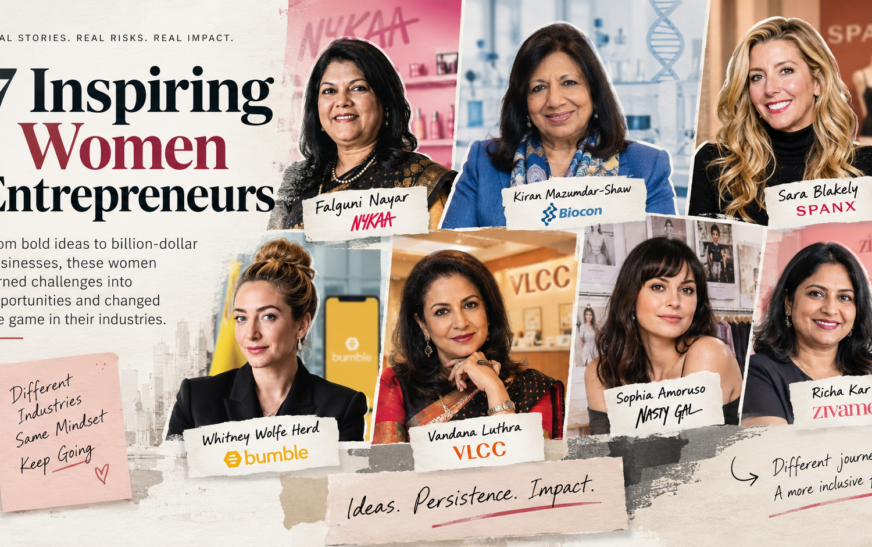
1. Falguni Nayar – Nykaa
Falguni Nayar spent close to two decades as an investment banker before she decided, at the age of 50, that it was time to build something of her own. Most people would call that late. She called it experience.
In 2012, she started Nykaa with about two million dollars of her own money, betting on a simple idea, Indian women deserved a trustworthy, well curated place to buy beauty products online. It wasn’t flashy. It was consistent, careful, and built on actual retail logic rather than hype.
By 2020, Nykaa had become India’s first unicorn led by a woman. When it went public in 2021, Nayar became one of the richest self-made women in the country. What makes her story stand out isn’t just the number on the valuation, it’s that she proved entrepreneurship doesn’t come with an age limit or a fixed starting point.
2. Kiran Mazumdar-Shaw – Biocon
Kiran Mazumdar-Shaw started Biocon in 1978, in a rented garage, with a business that most banks wouldn’t even touch. She was a woman trying to enter biotechnology in India at a time when the industry barely existed locally, and investors treated her idea with open skepticism.
She kept going anyway. Biocon started with enzyme manufacturing and slowly built its way into one of India’s most respected biopharmaceutical companies, eventually becoming publicly listed and expanding into affordable insulin and cancer treatment research.
What stands out about her story is the sheer persistence required to build a science heavy business from nothing, in an industry that didn’t yet have a roadmap for success in India. She didn’t just build a company. She helped shape an entire sector.
3. Sara Blakely – Spanx
Sara Blakely had no background in fashion, no formal business training, and about five thousand dollars in savings when she started Spanx. She was selling fax machines door to door before that, which is about as far from shapewear innovation as you can get.
The idea came from a personal frustration, she cut the feet off a pair of pantyhose and wore them under white pants to look smoother without visible panty lines. Most people would’ve left it there. She turned it into a product, manufactured it herself after being turned down by multiple factories, and built Spanx into a brand worth hundreds of millions of dollars.
Her story is a solid reminder that you don’t need a perfect resume to start something. You need a real problem and the stubbornness to actually solve it.
4. Whitney Wolfe Herd – Bumble
Whitney Wolfe Herd co-founded Tinder, then left the company after a deeply public and difficult split. Instead of walking away from the industry entirely, she came back with Bumble, a dating app built around a simple but genuinely different rule, women message first.
It wasn’t just a feature tweak. It changed the dynamic of how the app felt to use, and it resonated. Bumble grew fast, expanded beyond dating into friendship and professional networking features, and in 2021, Wolfe Herd took the company public, becoming one of the youngest female founders to lead a company to an IPO.
Her story isn’t just about building a successful app. It’s about rebuilding after a public setback and turning that experience into something sharper and more intentional the second time around.
5. Vandana Luthra – VLCC
Vandana Luthra started VLCC in 1989 with a single wellness centre in Delhi, at a time when the wellness and beauty industry in India was largely unorganized and informal. There was no established playbook for building a structured, professional chain of wellness clinics in the country.
She built one anyway, focusing on trained staff, standardized services, and a brand people could actually trust. VLCC grew into one of India’s largest wellness and beauty companies, eventually expanding into international markets across the Middle East, Africa, and Southeast Asia.
What’s notable about her journey is how much of it was about formalizing an entire industry, not just running a single successful business within it.
6. Sophia Amoruso – Nasty Gal
Sophia Amoruso started Nasty Gal as an eBay store in 2006, selling vintage clothing she sourced and photographed herself. No funding, no retail background, just a strong eye for style and an understanding of how to build a brand voice online before most people were thinking about that seriously.
The business grew into a full fledged online fashion retailer worth tens of millions of dollars within a few years. Her path wasn’t a straight line upward, the company later faced serious financial struggles and eventually filed for bankruptcy, but Amoruso’s influence on direct to consumer fashion branding, and her later book and platform Girlboss, left a lasting mark on how young founders think about building a brand from nothing.
Her story is a useful one precisely because it includes the hard parts. Growth, mistakes, and reinvention, in that order.
7. Richa Kar – Zivame
Richa Kar started Zivame in 2011 to solve a problem that most Indian retailers simply ignored, buying lingerie in India was uncomfortable, awkward, and underserved, especially online. She wanted to build a space where women could shop for something personal without the discomfort that came with doing it in a physical store.
It wasn’t an easy sell to investors at first. The category made a lot of people uneasy to even discuss seriously. But Kar pushed forward, built out sizing education, fitting guides, and a product experience designed specifically around what women actually needed, not just what was easy to stock.
Zivame grew into one of India’s leading intimate wear platforms, eventually expanding into offline stores as well. Her story reflects something a lot of women founders deal with quietly, building a business while also having to convince people the problem you’re solving is even worth solving.
What These Women Entrepreneurs Have in Common
Read through all seven stories back to back, and a few patterns show up again and again. None of them started with a perfect plan. Most of them were told, directly or indirectly, that their idea wouldn’t work. All of them kept building anyway, adjusting as they went rather than waiting for certainty that never would have come.
That’s really the throughline across most women entrepreneurs success stories, not luck, not a single brilliant idea, just consistent execution through a lot of uncertainty. It’s a pattern worth paying attention to if you’re building something of your own.
Final Thoughts
These seven women built businesses in industries that weren’t designed with them in mind, and did it anyway. Some of them pivoted hard, some of them stumbled badly before figuring it out, and all of them stayed in the game long enough to actually build something lasting. That’s probably the most honest definition of entrepreneurial success there is, not a straight line to the top, but staying in motion long enough to get there eventually.
If there’s one thing worth taking from these stories, it’s this. The playbook for women in leadership isn’t fixed. Every one of these founders wrote their own version of it.
FAQs
What makes these women entrepreneurs’ stories different from typical success stories?
Most of them didn’t come from traditional business backgrounds or start with major funding. Their success came from solving real problems and sticking with the business through setbacks, not from a single lucky break.
Are these examples relevant for someone starting a business in a completely different industry?
Yes, the lessons around persistence, problem solving, and adapting along the way apply across industries, not just beauty, fashion, or tech.
Did all of these women entrepreneurs succeed on their first attempt?
No, several of them faced real setbacks, including public failures and financial struggles, before building something that lasted.
Why is representation of women founders important in business media?
Seeing other women succeed in male dominated industries makes entrepreneurship feel more achievable and gives aspiring founders practical examples to learn from, not just inspiration.
What’s a common trait among most successful female entrepreneurs?
Persistence shows up again and again. Most of them faced rejection or skepticism early on and kept building anyway, adjusting their approach rather than giving up.