
Nobody wakes up one day and decides to build a billion-dollar company. Most of the founders you read about started with something much smaller: a few spare evenings, a few hundred pounds, and an itch they couldn’t ignore.
The popular version of these stories skips that part. You get the headline, a valuation, and a stock photo of someone looking confident. The slow, awkward middle is where the useful stuff is, so that’s what this post is about.
Below are four side hustle success stories, a look at what they have in common, and some practical advice for turning a side hustle into a business of your own.
Why so many businesses start as side hustles
A side hustle is the cheapest experiment you can run. You keep the salary and test the idea. If it flops, you’ve lost some weekends and not your livelihood.
Plenty of people are doing this. LendingTree’s 2026 report found that 33% of Americans have a side hustle, down from 38% in 2025. Surveys disagree a lot depending on how they define “side hustle,” and some put the share far higher, so treat any single number loosely.
The more interesting finding is about motive. One survey found that only about 20% of side hustlers were looking to build something they could eventually quit their jobs for. Most people just want extra money or some freedom. That means the founders below are the exception, and it’s worth looking at what they did differently.
Four side hustle success stories
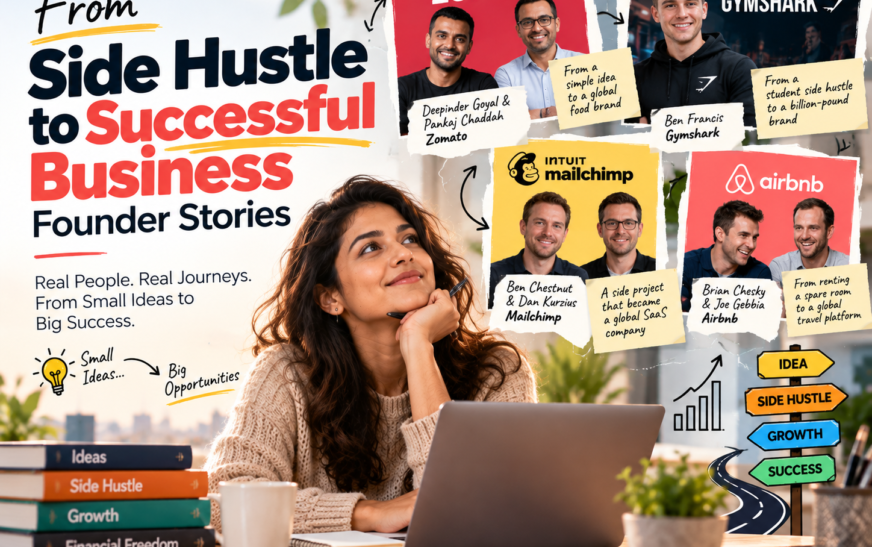
Deepinder Goyal and Pankaj Chaddah: Zomato
Zomato began as a lunchtime annoyance. Goyal and Chaddah were ordering in meals constantly while working at Bain & Company in New Delhi, so they put around 50 menu cards online on an intranet site just for Bain. Soon around 100 colleagues were visiting every day, and the site, then called Foodiebay, kicked off in July 2008.
Here’s the side hustle part. For almost a year and a half, Goyal stayed at Bain and spent his weekends collecting, scanning and uploading menu cards. The early numbers were modest. One profile says the site initially got just 25 users a day, and that his family was reluctant to see him leave a stable job. What kept him going was positive feedback from users about how convenient scanned menus were.
As Foodiebay grew into a larger operation, Goyal decided to quit Bain and become a full-time entrepreneur. The name changed to Zomato in November 2010. Info Edge invested $1 million in 2010, and Info Edge has put around ₹18 crore into the venture in total, according to Outlook Business.
The takeaway: the idea started as a free internal tool for an audience of about a hundred colleagues. When strangers wanted it too, that was the signal.
Ben Francis: Gymshark
Ben Francis was a university student delivering pizzas when he started Gymshark. He and his friend Lewis Morgan launched it in 2012. Francis later left Aston University, and he made the first garments in his parents’ garage with a sewing machine and screen printer bought with £1,000 of savings.
It didn’t start as a clothing brand. The first version was a website drop-shipping bodybuilding supplements. The money wasn’t there to make that work, though, because his Pizza Hut wages couldn’t cover the minimum order quantities that distributors required. So he pivoted to something he could make himself. The pivot is easy to miss, but a side hustle gives you room to change direction when the first plan hits a wall.
Social media did the rest. Francis has said Gymshark was one of the first businesses in the world to sponsor influencers. According to Forbes, daily sales jumped from about $450 to $45,000 after influencers started wearing the gear. In 2020, General Atlantic bought a 21% stake in a deal valuing the company at more than £1bn. By the year to July 2023, revenue had reached £556.2 million.
There’s a useful footnote here. Francis stepped aside as CEO in 2016 and brought in a former Reebok sales executive, and sales passed £100 million the following year. Knowing when you’re the right person for the job, and when you aren’t, is part of the founder journey too.
Mailchimp: the side project that outgrew the main business
This is probably the cleanest example of a side hustle becoming the real business. Ben Chestnut and Dan Kurzius launched Mailchimp in 2001 as a side project alongside their other internet businesses, which included a web design company.
The idea came from client complaints. The agency’s clients kept asking for an easier way to send email campaigns, so they built a simple tool. One account says they kept treating it as a nights-and-weekends project for about six years, and only dropped the web design work in 2007 once Mailchimp reached 30,000 paying customers. That’s one secondary source, so take the exact timeline as approximate. The pattern is the point: they waited until the numbers made the decision for them.
They also made a smart product call. An engineer suggested offering the product free up to a certain contact-list size, charging only beyond that.
The ending is remarkable. Intuit agreed to buy Mailchimp for about $12 billion in 2021, the largest acquisition in Intuit’s history and the largest ever of a company that had never raised venture capital. The two founders had rejected outside investment entirely, so each held a 50% stake.
The takeaway: the product came out of watching customers get frustrated. You can spot those problems from a day job or a client list, long before you have a business plan.
Tobi Lütke: Shopify
A caveat first: Shopify isn’t a textbook side hustle, but its origin is too good to leave out. Tobi Lütke had recently moved to Canada and wanted to sell snowboards online to make a bit of extra cash. The e-commerce software available in 2004 was clunky and expensive, so he wrote his own for his shop, Snowdevil.
He actually wanted to keep the store as a low-pressure hobby, because he was burnt out on programming. Then other merchants saw what he’d built and asked to license it, which led to the launch of Shopify in 2006. He shut down Snowdevil about two years later to focus on the software. Shopify went public in 2015.
The takeaway: sometimes the tool you build to run your side hustle is the real business. Pay attention to what people keep asking you for.
What these founder journeys have in common
Put the four stories side by side and some patterns show up.
They solved a problem they personally had. Blakely wanted better undergarments, Francis wanted better gym clothes, and Lütke wanted better store software. Mailchimp came from watching clients struggle. Nobody started with a market-size spreadsheet.
They stayed small for longer than the legend suggests. Spanx took roughly two years to reach shelves, and Mailchimp ran on the side for years. Overnight success is mostly an editing trick.
They learned the unglamorous skills. Patents, manufacturing minimums, sewing, billing software. The people who made it were willing to figure out boring things themselves.
Most kept control early on. Blakely and the Mailchimp founders took no outside money. That isn’t the only way to build a company, and Gymshark eventually sold a minority stake. But growing from your own revenue keeps your options open when you’re still finding your feet.
They paid attention to what customers did. Free tiers, influencer sponsorships, in-store demos. All of it came from watching real people use the product.
How to turn your side hustle into a business
You don’t need a billion-dollar idea to get started. Here’s a sensible order of operations.
1. Get your first paying customer before you polish anything. Chestnut reportedly had client projects lined up before his web design agency officially began. Payment is the clearest proof that someone wants what you’re making.
2. Track your numbers from week one. Revenue, costs and hours spent. Without that, you can’t tell whether you have a business or an expensive hobby.
3. Talk to customers directly. Blakely stood in stores answering shoppers’ questions. You can do the digital version with emails, comments and calls. Ask what almost stopped them from buying.
4. Sort out the legal and tax side early. Rules differ by country. In the UK, for example, earning more than the £1,000 trading allowance from a side hustle in a tax year may mean you need to complete a Self Assessment return. Check the current rules on gov.uk for your situation, since thresholds and deadlines do change. t
5. Reinvest before you spend. Early profit is more useful as stock, tools or marketing than as a nicer laptop.
When should you quit your day job?
There’s no universal answer, and anyone who gives you a magic number is guessing. But here are signals worth weighing:
- Your side income is consistent over several months, not just one good month.
- You have savings to cover living costs while income wobbles. Many advisers suggest six months or more.
- Your side hustle is already eating the hours you’d have to find anyway, and you’re turning down work because you can’t fit it in.
- You’re quitting toward something, not just running away from a bad week at the office.
Plenty of people stay in the “both” zone for years, and that’s fine. In one survey, 46% of workers said they’d leave their main job if the side hustle paid the same, while 39% said they enjoyed the side hustle more than the day job. Wanting out isn’t the same as being ready, though. The Mailchimp founders let customer numbers make the call. That’s a good habit to copy.
Common mistakes to avoid
- Waiting for the perfect idea. Blakely’s early idea was a footless pair of tights. It didn’t sound world-changing. Execution did the work.
- Telling everyone before you’ve tried anything. Blakely has said she kept her idea quiet for the first year so she wouldn’t spend it defending the plan.
- Scaling too fast. Fast growth can wipe out your margins, and Gymshark’s profit before tax actually fell in 2023 even as revenue rose.
- Ignoring your own limits. Hiring someone better at a job than you are, like Francis did, isn’t weakness.
FAQ
What is a side hustle?
It’s income-generating work you do outside your main job, from freelancing and online selling to building a product.
Can a side hustle really become a full business?
Yes, as Mailchimp and Shopify show. But most side hustles stay small, and that’s a perfectly good outcome.
How long does it take to go from side hustle to business?
It varies enormously. Spanx took about two years to reach stores, while Mailchimp ran on the side for years before it became the main focus.
Do I need investors?
Not necessarily. Spanx and Mailchimp both grew without outside capital, though other founders have good reasons to raise money.
Final thoughts
None of these founders had a perfect plan. They had an annoying problem, a bit of stubbornness and the patience to keep going while still holding down other work. That’s a founder journey most people can actually start.
So pick one small thing this week. Make one sale, talk to one customer, or write down your numbers. That’s how every story above began.